
GHustavo Távora - We Are River People
“I am a net weaver, connecting fish, rivers, and people”
GHustavo Távora
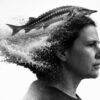
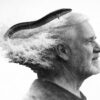
For Brazilian artist GHustavo Távora, fish art and educational activities provide a way to get people thinking about our impact on the planet. Picking up rubbish and other disposed material in his local river, the Capibaribe, which he points out is the seventh most polluted river in Brazil, he transforms Styrofoam into fish stamps, which he uses to reproduce colorful images of fish and people, during World Fish Migration Day (WFMD) festivals. He uses this art to demonstrate that even a polluted river can produce beauty, and through the process, motivate people to think about the coexistence among people, cities, rivers and fish .
Távora lives in Recife, the capital city of Pernambuco State, in the northeast of Brazil. Recife, is a coastal city by the Atlantic Ocean, and two main rivers run through the city, the Capibaribe and Beberibe rivers. Growing up, he enjoyed spending time in nature along the beach, where he used to go on weekends and vacations as a child, along with his family. The beach is on an Island called Itamaracá. He caught crabs among the mangroves and enjoyed fishing with his father and older brother. He and his brother also enjoyed sailing on a second-hand boat a gift from their father. He confesses that, as a boy, he remembers being told to dump rubbish into the mangroves behind their beach house, because that is what everyone did. It was a cultural behavior in the neighborhood, prompted by the absence of any public policy for dealing with rubbish generated by the Island’s residents and tourists. As he grew older though, he recognized the harm humans are doing to the environment. Now he thinks of himself as a cosmologist, someone who recognizes our place in the universe and our need to coexist. He sees the need to slow consumption, reuse and recycle, and preserve and restore the environment.
Távora studied graphic design at Universidade Federal de Pernambuco (Federal University of Pernambuco ). For 15 years, he taught English at one of the most important local English Schools, where he developed his teaching skills and experience in dealing with a vast range of people, from children to adults. He started using his graphic design training to make and teach art, as well as develop innovative education programs and projects. In 2008, he was invited by the British Council along with another artist, to work at three schools in town, promoting art labs and designing three pieces of art about the Capibaribe River. His work was exhibited at the Rivers of the World art exhibition at the Thames Festival, held in London.
”We should value natural resources above material things. Im a human and humanity is the problem so I am trying to contribute.

Eventually, he was working on an event at the university for the Sociedade Brasileira pra o Progresso da Ciência (SBPC ), the Brazilian Society for Science Development, the biggest Scientific event in Brazil. It was there that he first heard of WFMD. The university had been invited to take part in the first celebration of WFMD. Tavora was invited to develop a series of artistic activities to enrich and promote public engagement during the celebration.
Távora was excited to see the public interacting with the colorful fish sculptures, banners and paintings which were placed throughout the city to celebrate WFMD. “I love World Fish Migration Day,” Távora says. That is why he has continued to contribute his art, creativity and educational talents to promote WFMD online and in person throughout the world. “I am a net weaver, connecting fish, rivers, and people,” he says.
He has created art to celebrate WFMD for every celebration since 2014. Like the fish he creates, he has made his own migrations. Often at his own expense, Távora travels to festivals across Brazil ,Uruguay and Argentina to spread the word about WFMD and fish. He has created a blog for his art at https://capibariberiodevida.blogspot.com/ .
Although he does not have children of his own, Távora worries about the future for everyone’s children. He takes solace from the fact that he has changed himself, going from a boy who threw rubbish in the river to a man who works to protect rivers through his art and outreach.
“Life is a gift,” Távora says. With that in mind, he takes time to enjoy the ocean, practice yoga, ride his bicycle, and to live sustainably.
Távora hopes his work and behavior inspires and motivates people to value clean water, clean air, and healthy food. “We should value natural resources above material things. Im a human and humanity is the problem so I am trying to contribute.”
Register an eventBy Bob IrvinRetired President and CEO, American Rivers