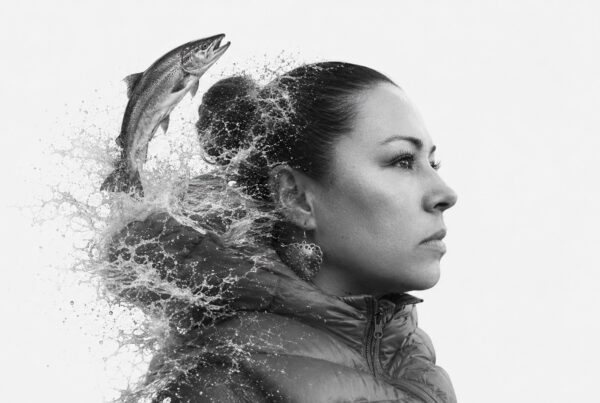


Maurice Toetoe - We Are River People
Tawhiuau is my sacred mountain
Rangitaiki is my Ancestral River
Rangipo is where my ancestors farewell the migrating eels
Ngati Manawa is my Tribe
Tangiharuru is my eponymous ancestor
“Knowing our history, knowing our stories, knowing our songs inspired me”
Maurice Toetoe
When Maurice Toetoe speaks of eels in New Zealand, he is not speaking of just a fish, but much deeper relationships of ancestry and his tribal homeland. Toetoe, a Māori tribesman, explains these relationships in his language:
PEPEHA
Ko Tawhiuau te maunga
Ko Rangitaiki te awa
Ko Rangipo te wehenga o te tuna
Ko Ngati Manawa te Iwi
Ko Tangiharuru te Tangata
In English, this translates to:
Tawhiuau is my sacred mountain
Rangitaiki is my Ancestral River
Rangipo is where my ancestors farewell the migrating eels
Ngati Manawa is my Tribe
Tangiharuru is my eponymous ancestor
In the 1950’s, when Toetoe was a boy growing up in New Zealand, the Rangitaiki, his ancestral river, still flowed freely and provided abundant habitat for longfin eels, called tuna in Toetoe’s language. Endemic to New Zealand, longfin eels are long-lived catadromous fish, spending most of their lives in freshwater rivers and lakes, migrating at the end of their lives thousands of kilometers to their ocean spawning grounds near the island of Tonga in the South Pacific. Longfin eels only spawn once, at the end of their lives, with males spawning around 23 years of age and females anywhere from 100 to 150 years old. Their eggs float to the surface where they hatch into larvae that are carried by ocean currents back to New Zealand estuaries. There the larvae are transformed into glass eels, tiny transparent eels. Eventually, they grow to become juvenile eels, known as an elver, which move into rivers and connected lakes. Eels are remarkably agile climbers, able to ascend rocks and waterfalls hundreds of kilometers deep in the New Zealand terrain. Male longfin eels generally grow to a length of 66 cm, but can grow up to 73.5 cm. Females are larger, and longer-lived, reaching an average length of 115 cm, but some are known to grow to 156 cm. Eels are apex predators, omnivorous and opportunistic, feeding on insects, smaller eels, fish, frogs, and even ducklings.
”Keeping watch to make sure the river is treated with reverence

Toetoe learned from his elders to hunt eels while also respecting them. He says his tribe’s genealogy traces back to eels as their kaitiaki. Eels are guardians of the river, Toetoe says, keeping watch to make sure the river is treated with reverence. His elders taught him the land and observed his skills as he learned to hunt ethically, always keeping the next generation in mind. He learned to make flexible tube-shaped nets to capture eels. He learned how to prepare eels for feeding his family or a feast for guests. Toetoe says his grandfather taught him to use the pumice sand found along the river to clean the slime from the eel skin before gutting it. The eel meat, rich in healthful omega-3 fatty acids, can then be dried or cut it into pieces, wrapped in the flax plant that grows along the river, and baked in coals beneath the sand along the river. Toetoe has passed along these skills to his own sons, one who now lives in Australia and his other son with whom he operates a tourist business in New Zealand, as well as his four grandchildren.
Longfin eels are now listed as endangered on the IUCN Red List, primarily due to habitat loss. Beginning in the 1960’s and continuing into the 1980’s, without any consultation with Maori tribes, four dams were constructed on the Rangitaiki River and its tributaries to generate hydropower. The diversion of water into lakes and inadequate fish passage for migrating eels has resulted in steep declines of eel populations in the river. Toetoe says that after the first dam was built on the river, there was no eel migration in the river for 23 years, until 1986. Tribal elders said something must be done to restore the eels.
Toetoe and others in his tribe began capturing adult eels above the dams and releasing them below the dam closest to the mouth of the river, enabling the released adult eels to swim to their oceanic spawning grounds near Tonga. Another tribe on a nearby stretch of the river is also doing similar catch and release of adult eels and elvers. Toetoe says the results are encouraging, with a growing abundance of ages and sizes of eels in the river. Through their Treaty of Waitangi settlement and the co-governance arrangements that followed, the Crown (government agency) is now required to work alongside Iwi (maori tribes) in the management of their rivers. These arrangements acknowledge their role as kaitiaki (guardians) and their enduring relationship with the awa (river). However, while progress has been made, there is still significant work to do. Barriers to fish passage, both upstream and downstream, continue to impact tuna (eel) and other taonga (treasure) species, and these issues must be addressed if the health and mauri (life source) of the river are to be truly restored. Toetoe says the tribes are pushing for installation of improved bypass facilities on the dams to allow eels to migrate upriver and down. With financial support from the power company operating the dams, Toetoe’s tribe has recently begun a tagging program so eels can be tracked to further aid their recovery.
”I am the eel and the eel is me.
For Toetoe, the restoration of eels to his ancestral river is personal. “Knowing our history, knowing our stories, knowing our songs inspired me,” he says.
He then recites WHAKATAUKI, a tribal proverb, « Ko au te tuna, Ko te tuna ko Au,” which translates to, « I am the eel and the eel is me.”
Register an eventBy Bob IrvinRetired President and CEO, American Rivers